
Leïla est une étudiante en Master de droit pénal comparé et Relations internationales axés sur la criminologie et pénologie. Elle se spécialise en politique carcérale au niveau des forum internationaux tels que l’UNODC. Elle a rejoint les alumni en 2024 et est actuellement Présidente et co-responsable du Pôle Réseaux – branche communication.
Introduction
In 2010, David Garland adopted an innovative view on Capital punishment in the US, setting aside the institutional framework of the death penalty, and partisan arguments. Instead, he chose to “regard capital punishment not as a moral dilemma to be addressed or a policy issue to be resolved but as social fact to be explained”. In the complex realm of global justice and diplomatic relations, the death penalty remains a persistent and contentious debate between individuals and States alike, bringing international and regional organizations into the political arena. As the pendulum of public opinion swings, and the legal and international systems evolve, capital punishment remains a source of tensions between international actors. This is especially true for US–EU relations, which are increasingly strained by the U.S.’s zealous refusal to adopt an abolitionist stance regarding the significance of the topic.
The death penalty, also referred to as capital punishment, is the state-sanctioned sentence, often considered the highest possible sanction for an individual, leading to the execution of one for a specific crime.
According to historical archives, its use dates back to Ancient Greece and was widely employed under Draco’s laws; Draco being a 7th century BC Athenian lawgiver renowned for his harsh legal code, punishing both trivial and serious crimes with death sentences. The Romans, along with adherents of Christianity and Judaism, also found justifications for its use. For example, Genesis 9:6 “Whosoever sheddeth man’s blood, by man shall his blood be shed.” It was also customary in other parts of the world : for instance, in Japan during the civil war of the mid-11th century. In Islam, as expressed in the Qur’an, capital punishment is tolerated (though not encouraged by public opinion) for certain ḥadd(fixed) crimes. However, murder is treated as a civil offense under the law of qiṣāṣ (retaliation).
The abolitionist movement traces its roots to the 18th century, with early contributions from European theorists such as Montesquieu, Voltaire, and Bentham. However, it was Beccaria’s essay On Crimes and Punishments that sent a shockwave around the globe. In it, Beccaria theorized that there was no justification for the state’s taking of a life. The essay gave abolitionists a strong voice and renewed energy; one consequence being the abolition of the death penalty in Austria and Tuscany.
Nevertheless, the abolitionist movement only gained significant momentum toward the end of the 20th century, as the number of abolitionist countries grew exponentially. These countries, together with those that are “de facto” abolitionists (capital punishment is legal but not exercised) now account for more than half of the world. This is mainly due to the fact that the issue has evolved from a purely domestic concern to a substantive international human rights matter.
Transatlantic relations between the EU and the US have experienced their fair share of ups and downs, with the Cold War providing the geopolitical context and framework for it in the mid-20th century. Nevertheless, transatlantic relations have deteriorated over the last two decades, with the Trump administration (2017-2021) straining them more than any other situation in recent history. Divergent positions on key issues led to fundamental disagreements.
Among these tensions, the death penalty remains a particularly contentious issue. While capital punishment is banned across the EU, where it is regarded as a core value and enshrined in the 2000 Charter of Fundamental Rights of the European Union, the U.S. remains divided. Efforts to abolish the death penalty at the federal level have largely failed, with most bills dying in committee. Currently, only 24 out of 50 states have abolished it. These diametrically opposed positions have led to frequent disagreements, but also to a mutual recognition of differences, which makes it an ideal topic to analyze in order to understand the complexity of transatlantic diplomacy.
As such, the first part of this article will briefly retrace the history of the death penalty in the EU and the US. This will be followed by an examination of the current state of the death penalty in the United States, after which the EU’s diplomatic response will be analyzed. Last but not least, the US response to the reactions and the current states of the most recents development of the relations on the topic will be presented.
A short history of the death penalty
In the EU
Supranational level
The history of the death penalty in the European Union reflects the non-linear moral and legal developments, marked by shifts from rationalist thought to human rights ideals, with both ruler and ruled falling under the same rights. Indeed, rulers and subjects alike ought to be considered equal as human beings, a principle often referred to as the sanctity of life.
In the aftermath of World War II, when the horrors of the Holocaust underscored the need for a new approach to justice and morality, the European Union rooted its commitment to human rights in the broader moral awakening of European societies. As a result, the first milestone in the EU’s path against capital punishment was the adoption of the European Convention on Human Rights (ECHR) in 1950. Although adopted under the Council of Europe, the ECHR was shaped in part by prominent European statesmen who would later play key roles in the process of European integration, including Konrad Adenauer, then Chancellor of Germany. At the time, it included provisions guaranteeing the right to life as well as prohibiting torture and inhuman or degrading treatment.
The next development came in 1997 with the Treaty of Amsterdam, which explicitly affirmed respect for fundamental human rights, including the right to life. Only one year later, to further reinforce its commitment, the Council adopted the EU Guidelines on the Death Penalty, drafted by the Working Group on Human Rights and largely based on the work of the UN General Assembly. These guidelines specifically set out the Union’s objectives regarding this matter. According to them, in non-abolitionist countries, the EU should advocate the establishment of a moratorium, or at least press for a more restricted use of the death penalty and for respect of minimum standards in line with international law. As such, the EU adopted a dual approach: committing to abolish the death penalty within the Union while also advocating for its abolition abroad.
This was reiterated in 2000 by the Charter of Fundamental Rights of the European Union, which explicitly prohibits the use of the death penalty within the EU. As it was given the same legal value as other EU treaties, it became primary law and thereby gained supremacy over both the national laws of Member States and secondary EU law.
Ever since then, the EU has continued to uphold its commitment and advocate the abolition of capital punishment worldwide. Between 2015 and 2019, the EU Action Plan on Human Rights and Democracy was published, including Objective No.15, which focuses on combating torture, ill-treatment, and the death penalty.
Besides these internal and legal measures aimed at abolishing the death penalty, the EU also maintained its diplomatic position by expressing its opposition in international forums. It has supported the adoption of several resolutions by the UN General Assembly. The first such resolution, approved on December 18, 2007, established a moratorium on the use of the death penalty. Since then, the UNGA has discussed a new resolution on a moratorium on the use of the death penalty every two years.
Furthermore, the EU actively promotes the global abolition of the death penalty through its foreign policy and external actions, engaging in diplomatic efforts with states that still practice capital punishment. A prime example of this is the United States, renowned for the strength and resilience of transatlantic relations.
Although the EU and its Member States generally act in unison, discrepancies can be observed in their path toward the abolition of the death penalty, with some Member States being less committed to its abolition.
States level

Despite a common movement at the supranational level, a multi-speed geometry can be observed at the member states and partners level.
Indeed, Portugal was the first Member State to suspend executions in 1849, although it abolished the death penalty for all crimes in 1982 following pressure from the EU. This is particularly surprising given Portugal’s limited international engagement on human rights and its modest global influence. Influenced by the same post-war developments that shaped the Union, individual Member States also reconsidered their ethical and moral standards regarding capital punishment, leading to a noticeable trend toward abstention from executions, though not yet full abolition. The 1950s and 1960s witnessed a wave of abolitions, driven by growing skepticism about the effectiveness and ethics of the death penalty, with several countries such as Luxembourg, Belgium, Ireland, the Netherlands, Denmark, and Italy following suit.
The EU’s expansion from the 1970s to the 1990s added new member states with varied histories regarding the death penalty. The accession process often involved a commitment to align national legislation with EU principles, including the rejection of capital punishment. This harmonization contributed to an effective shift from abstention to abolition. Austria was among the first to abolish the death penalty in 1968, with other member states gradually following suit. Once the abolition of the death penalty became a fundamental EU value, it had a significant impact on the countries of Central and Eastern Europe, prompting several of them to adopt abolition, such as Hungary, Romania, the Czech Republic, and Slovakia…
Despite the EU’s unified position, there have been challenges within the Union. Some member states retained capital punishment even after joining the EU, prompting internal dialogue and legal reforms. Notably, the last execution in an EU member state occurred in France in 1981, before the practice was fully abolished, following a speech by the eminent French politician Robert Badinter, then Minister of Justice. This is notable given France’s role in the foundation of the EU and its subsequent actions. Latvia also lagged behind in its engagement, with its last execution occurring in 1996 and the law abolishing capital punishment only being passed in 2012.
It is evident that the EU’s road to abolition was not linear per se, but it nonetheless managed to maintain a degree of consistency, enabling it to advocate for the abolition of capital punishment worldwide, particularly in the United States, where the history of the death penalty has been especially contentious.
In the US
The history of the death penalty is a mosaic which has nothing to envy the European Union’s. The complexity of its evolution reflects its two-level narrative between the federal and states with ever changing attitudes toward justice, morality, and human rights.
Federal level
The origins
The death penalty was not really a federal conviction in the early years, but mostly as a colony individual decision.
Nevertheless, starting in the late 18th century, the federal government asserted its authority by enacting the Crimes Act of 1790, also known as the Federal Criminal Code of 1790, and assumed control over capital punishment, as the use of the death penalty in U.S. territories had previously been administered by the U.S. Marshals Service and federal judges. It defined some capital offenses: murder, piracy, hostility against the United States (patriotism being highly important for Americans), and treason. The first federal execution occurred that same year: Thomas Bird was executed for murder. This was followed by a series of federal executions, with the last pre-Furman federal execution taking place in 1963, when Victor Feguer was executed for kidnapping and murder after President John F. Kennedy denied clemency.
Initial ban
In the 18th century, still influenced by European ideas, Americans began to shift their societal attitudes toward the death penalty and initiated reforms aiming at a partial ban on its use. The first attempt to reform the death penalty in the U.S., which was ultimately unsuccessful, was made by Thomas Jefferson when he introduced a bill to revise Virginia’s death penalty laws. The idea was to restrict its application to convictions for murder and treason. However, the bill was defeated by a single vote.
In the wake of the World Wars and the atrocities committed, as Europe began to develop a stronger sense of human rights and morality, Western Europe experienced a resurgence in the use of the death penalty. One by one, all Western European nations and Canada abandoned capital punishment, leaving the United States as the last Western democracy still carrying out executions. Two factors help explain this trend: the writings of late 19th-century criminologists who argued that the death penalty was a necessary social measure, and Americans’ reactions to Prohibition and the Great Depression. As a result, there were more executions in the 1930s than in any other decade in American history, with an average of 167 per year. In the 1950s, the European Communities and their stance on human rights traveled the Atlantic and reached the US, leading to a dramatic decrease in federal executions. Whereas there were 1,289 executions in the 1940s, there were 715 in the 1950s, and the number fell even further to 191 between 1960 and 1976. According to a Gallup poll, support for capital punishment reached an all-time low of 42%.
It was the SCOTUS that triggered the process with a series of decisions, notably the major and most explicit shift highlighted by Furman v. Georgia, 408 U.S. 238 (1972), when the Court chose to invalidate existing death penalty laws as they constituted cruel and unusual punishment under the Eighth Amendment. The Court’s reasoning (ratio decidendi) was twofold: (1)the existing laws terminated life in exchange for marginal contributions to society; and (2) the laws resulted in a disproportionate application of the death penalty, specifically discriminating against impoverished and minority communities. This was a major case, largely aligned with the path chosen by the EU by this time. However, this progress came to a halt only four years later.
Reinstatement
In Gregg v. Georgia, 428 US 153 ( 1976 ), the Court refused to expand the scope of Furman in terms of arbitrariness. In accordance with the eminent American criminologists thoughts , The SC held the death penalty was not per se unconstitutional as it could serve the “social purposes of retribution and deterrence”.
Nonetheless, it created key requirements in the following years :
The proportionality requirement was developed in Coker v. Georgia, 433 U.S. 584 (1977), where the SCOTUS held that the imposition of the death penalty must be proportional to the crime, because otherwise it would violate the Eighth Amendment’s prohibition against cruel and unusual punishment.
The Principle of Individualized Sentencing was instilled in Ring v. Arizona, 536 US 584 ( 2002) and hold that it is unconstitutional for “a sentencing judge, sitting without a jury, to find an aggravating circumstance necessary for imposition of the death penalty” meaning the jury must be guided by the particular circumstances and thus conduct an individualized sentencing process.
On a more legislative side, since 1999, 15 Federal Death Penalty Abolition Acts died in Committee, with a record number of 87 co-sponsors in 2021 but a majority of 1 co-sponsor throughout the years . The latest in date, from the 118th Congress, remain as “introduced” since February 2023 :
| Congress | Short title | Date | (co)sponsors | Latest status |
| 106th Congress | Federal Death Penalty Abolition Act of 1999 | November 10, 1999 | 2 | Died in Committee. |
| 107th congress | Federal Death Penalty Abolition Act of 2001 | January 25, 2001 | 2 | Died in Committee. |
| 108th Congress | Federal Death Penalty Abolition Act of 2003 | June 24, 2003 | 47 | Died in Committee. |
| Federal Death Penalty Abolition Act of 2003 | February 13, 2003 | 1 | Died in Committee. | |
| 109th Congress | Federal Death Penalty Abolition Act | March 9, 2006 | 46 | Died in Committee. |
| Federal Death Penalty Abolition Act of 2005 | January 24, 2005 | 1 | Died in Committee. | |
| 110th Congress | Federal Death Penalty Abolition Act of 2008 | September 11, 2008 | 20 | Died in Committee. |
| Federal Death Penalty Abolition Act of 2007 | January 31, 2007 | 1 | Died in Committee. | |
| 111th Congress | Federal Death Penalty Abolition Act of 2009 | March 19, 2009 | 1 | Died in Committee. |
| 112th Congress | Federal Death Penalty Abolition Act of 2011 | September 23, 2011 | 16 | Died in Committee. |
| 113th Congress | Federal Death Penalty Abolition Act of 2013 | December 12, 2013 | 14 | Died in Committee. |
| 116th Congress | Federal Death Penalty Abolition Act of 2019 | July 25, 2019 | 68 | Died in Committee. |
| 117th Congress | Federal Death Penalty Abolition Act of 2021 | January 4, 2021 | 86 | Died in Committee. |
| Federal Death Penalty Prohibition Act | January 11, 2021 | 80 | Died in Committee. | |
| Federal Death Penalty Prohibition Act | March 3, 2021 | 21 | Died in Committee. | |
| 118th Congress | Federal Death Penalty Abolition Act of 2023 | February 21, 2023 | 25 | Referred to Committees of Jurisdiction |
In practice, The federal executions of Louis Jones, Jr., on March 18, 2003, and those of Timothy McVeigh and Juan Raul Garza, on June 11 and 19, 2001, marked the beginning of the 17 years hiatus practiced by the US at the federal level, which brutally ended under the Trump presidency.
States level
The origins
Interestingly enough, it was the European influence who was the precursor of the US State level path toward both the use and abolition of capital punishment. Although not yet the Union, its ancestors did most of the work, settling in the new world and bringing with them their practice regarding this topic.
The first recorded execution in the European colonies took place in Virginia in 1608, of a captain accused of spying for Spain. Following this event, Virginia Governor Sir Thomas Dale enacted the Divine, Moral and Martial Laws in 1612, establishing the death penalty for even minor offenses, such as killing chickens. Some might argue that the ludicrousness of certain laws in the United States can still be observed today, not only in the 17th century. The use of capital punishment varied from colony to colony, just as previously it varied from one European country to another, and today it varies from one U.S. state to another. The first recorded execution in the Massachusetts Bay Colony took place in 1630, with the Capital Laws of New England going into effect years later, while the New York Colony instituted the Duke’s Laws in 1665.
The ( partial ) bans
It was a future US Attorney General which triggered the change at state-level. Although not completely against it, Bradford believed it was not a deterrent to certain crimes. He eventually led Pennsylvania to limit the scope of death penalty by repealing capital for all offenses except first degree murder. During this period, some states limited the crimes punishable by death and introduced more regulated methods of execution. In 1846, the state of Michigan became the first to abolish it for all murders and other common crimes. So far, 23 states and the district of Columbia banned the capital punishment, while 4 of the 27 other states offer a gubernatorial Hold on Executions.

This complex mosaic is not quite finished today, with the current state of capital punishment still sparking debate at the federal level and state level alike.
The state of death penalty in the US ( since 2019 )
According to recent studies, the death penalty in the United States is in a state of decline and transition. While still persisting in some areas and states ( 60% of the states and federal government retained it under various circumstances), there is a notable decrease in executions and new death sentences and a remarkable shift in officials’ and public opinion on the matter.
However, things might take a turn for the worst with newly re-elected President Donald Trump and his views on the matter.
Legal position
Constitutional position
Although no article of the U.S. Constitution explicitly prohibits or allows it, the topic has traditionally been associated with the Fifth, Eighth, and Fourteenth Amendments. Initially, these amendments were interpreted as permitting the death penalty. However, in the early 1960s, the interpretation of the Eighth Amendment shifted toward a partial prohibition of capital punishment, with courts interpreting it as a form of “cruel and unusual” punishment, and therefore directly unconstitutional in certain applications.
No major constitutional development has been done ever since, although nothing is expected as the US Constitution is quite rarely amended.
International engagements
In spite of the absence of an explicit constitutional provision, the international position on the issue is somewhat clearer, reflecting an abolitionist stance that urges the United States to align with international norms. Indeed, the United States is a party to various international agreements and treaties addressing, or at least referring to, the issue of capital punishment.
A major international agreement of particular importance is the ICCPR of 1966, which the United States ratified in 1992 and remains a party to this day. Article 6 of the ICCPR recognizes the right to life and establishes safeguards for the application of capital punishment. It calls upon states that have not abolished the death penalty to limit its application to the most serious crimes and to provide certain procedural protections for those facing it. In this regard, the United States has diligently submitted periodic reports to the Human Rights Committee, and continues to do so, regarding its compliance with the objectives of the ICCPR. On June 7th, 2023, according to the official schedule, the Department of State hosted the fifth periodic Civil Society Consultation, during which the topic of the death penalty was discussed. Correspondingly, their report states that:
“The Supreme Court has ruled that the death penalty does not violate the Eighth Amendment’s ban on cruel and unusual punishment, but that the Eighth Amendment does shape certain procedural aspects regarding when the death penalty may be used and how it must be carried out, see, e.g., Gregg v. Georgia, 428 U.S. 153 (1976), Ford v. Wainwright, 477 U.S. 399 (1986), and Baze v. Rees, 553 U.S. 35 (2008).”
Following a report, the Committee traditionally identifies specific recommendations for each State party which require immediate attention and can be implemented within a year. Earlier periodic reports presented by the US Government demonstrate substantial collaboration among various government agencies, involving extensive input and the inclusion of insights gathered through consultations with both civil society and the American public. In its latest concluding observation to the US, on October the 17th 2023, the Committee stated that :
“While welcoming the reinstatement of a temporary moratorium on federal executions and the increased number of states that have abolished the death penalty, the Committee remains gravely concerned at the continued use of the death penalty”
“ the State party should:
(a) Establish a de jure moratorium on the use of the death penalty at the federal level, engage with retentionist states to achieve a nationwide moratorium and take concrete steps towards the abolition of the death penalty;(…)”
Despite this commitment, the USA still has not ratified the Second Optional Protocol to the ICCPR, which aims at the abolition of the death penalty. This reluctance is a common thread among States as they often see this type of engagement as a loss of their sovereignty.
The United States is also a party to the Convention Against Torture, which prohibits the use of torture and cruel, inhuman, or degrading treatment or punishment. While the CAT doesn’t explicitly address the death penalty, it establishes a framework against cruel and unusual punishment which is often put in relation with the death penalty by abolitionists. Once again, it has not ratified the optional protocol which aim is to establish an independent international or national system of supervision in order to prevent torture and other cruel, inhuman or degrading treatment or punishment.
Although the United States has at times joined the international community in condemning the unlawful actions of other retentionist countries, it has consistently ignored the Inter-American Commission on Human Rights (IACHR)’s precautionary measures for American death-row prisoners. In 2023, the IACHR granted precautionary measures for Michel Tisius, a resident of Missouri. Despite this, Mr. Tisius was executed on June 6. This illustrates the duality of the United States, participating in the international abolitionist movement while maintaining its status as a global outlier in the use of the death penalty.
Lastly, the US is a member state of the United Nations, and more so of the UN Security Council, which entails a certain pressure and dialogues regarding the abolition of capital punishment. On 17 December 2024, the UNGA adopted the 10th resolution for a moratorium on the use of the death penalty. Among the 32 votes against, a particular focus was on the USA which maintained this position for the 10th time.

It’s important to note that international agreements and treaties are subject to interpretation and implementation at the domestic level and that the US has a fluctuating position toward international law and its international obligations in relation to the treaties they are party of.
National legislation
After 15 failed Federal Death Penalty Abolition Acts, the 118th Congress introduced the Federal Death Penalty Abolition Act of 2023 on February 21st, 2023. Co-sponsored by 26 representatives so far, the bill is still stuck to the introduction stage as of today, which might say something about the importance and priorities of the issue.
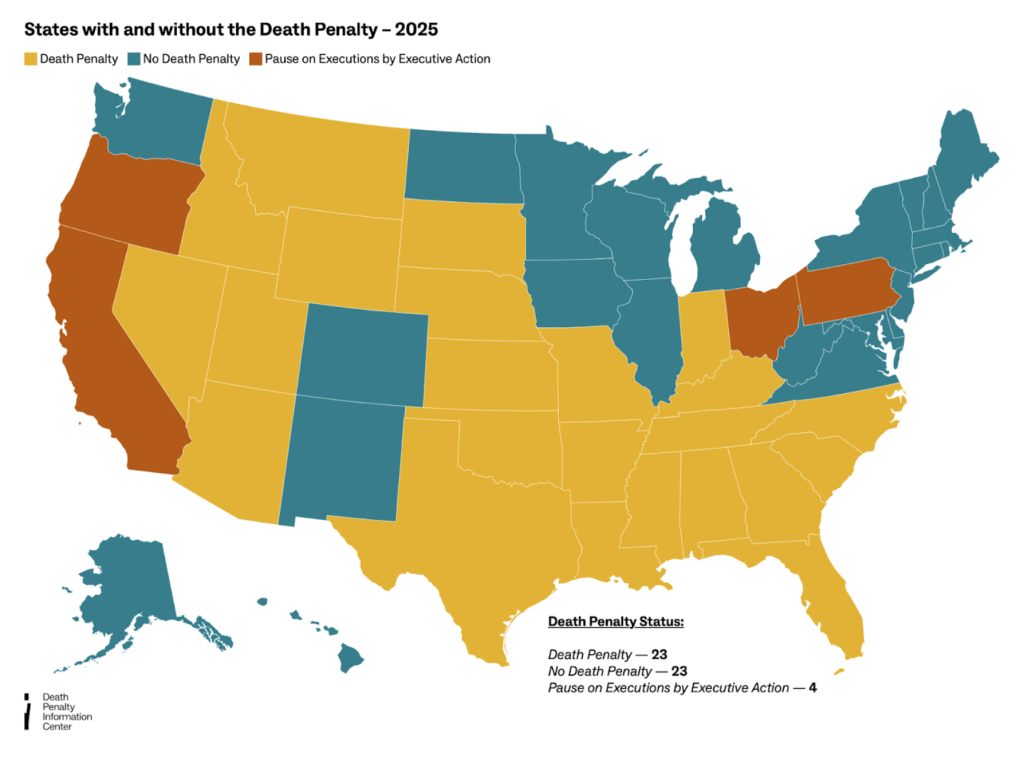
In addition, numerous states are leaning toward a serious limitation of the scope of the death penalty : With 11 states having no-recorded executions in 10 years, 3 states with Governor-Imposed Moratorium, and a good amount of states with a ban on death penalty, the state-level is going on the rather good road. Alabama is discussing a bill which would require a unanimous vote by jurors to impose a death sentence, North Carolina has introduced a bill to repeal the death penalty altogether.
Even more recently, Ohio officials shifted toward abolition. The legislature proposed a death penalty repeal bill in December 2023, drawing attention to the state’s five-year pause on executions, and leading state officials from both parties to question whether the death penalty system is working. Ohio Attorney General, David Yost, quickly gave a sense to the situation by stating that :
“This system satisfies nobody. Those who oppose the death penalty want it abolished altogether, not ticking away like a time bomb that might or might not explode. Those who support the death penalty want it to be fair, timely and effective. Neither side is getting what it wants while the state goes on pointlessly burning through enormous taxpayer resource”.
Although Ohio has issued execution warrants for numerous dates through 2028, Governor Mike DeWine has indicated that no executions will be performed unless the legislature adopts a new method of execution. In 2020, he called lethal injection“impossible from a practical point of view.” This furthermore intensifies the decline of the death penalty in the US and showcases a certain double level EU process which occurred in the second half of the XIXth century. And just like the EU, other considerations played their part, such as the political and diplomatic positions.
Political and diplomatic positions
Although all positions are interrelated, it is important to analyze the political and diplomatic position on the topic of capital punishment as it is perhaps the main influencer of the US external relations, including the EU-US one. As the focus is on the post 2019 situation, it appears interesting to analyze but also compare Donald Trump Administration position and Joe Biden Administration position.
The previous Trump presidency was, to say the least, bumpy which led to some troubles in the relationship with the EU.
Regardless of media framing, the facts are clear: Donald Trump and his administration ended the 17-year hiatus on July 14, 2020, with the execution of Daniel Lee. Thirteen federal executions took place afterward, three of them conducted at the last moment before the Biden presidency began. This is consistent with statements made by Trump himself, in which he expressed a strong and consistent stance in favor of the death penalty. He advocated for capital punishment as a deterrent for certain crimes, particularly those involving violence against law enforcement officers or acts of terrorism. In the aftermath of the deadly terrorist attack in New York City in October 2017, Trump publicly called for the death penalty for the perpetrator.
Regardless of Trump’s personal positions and statements, an interesting development occurred in 2022. In his 2022 book, former Attorney General Bill Barr revealed that he was the one who proposed resuming federal executions, with Trump serving primarily as the public figurehead for this initiative. According to Barr, they discussed the topic only once. During this discussion, President Trump inquired about Barr’s support for capital punishment, which led to Trump’s acceptance of this position. This is consistent with the 2019 DOJ policy changes initiated by Barr.
This led to a policy reversal under the Biden administration. President Joe Biden has a long history of expressing concerns about the death penalty, and this stance, although not always consistent, has strengthened over the years. While he has not been a staunch advocate for abolition, he has adopted a more cautious and restrictive approach.
During his 2020 presidential campaign, Joe Biden expressed a commitment to work toward the elimination of the federal death penalty. He pledged to encourage states to follow suit and end the use of capital punishment, particularly by adopting policies that replace the death penalty with alternative sentencing measures.
IIn one of his first acts as President, on January 20, 2021, Joe Biden signed an executive order to halt federal executions. The moratorium on federal executions marked a clear departure from the Trump administration’s efforts to resume capital punishment at the federal level. When Trump’s victory was announced in November 2024, President Biden anticipated that the United States would likely face a setback on this issue. As a result, he commuted the death sentences of 37 men on federal death row. This proved useful, as on January 20, 2025, President Donald Trump signed an executive order to “restore” the federal death penalty. Although lacking many important details, the order instructs the Department of Justice’s Attorney General to “pursue the death penalty for all crimes that are deemed sufficiently severe to warrant its use,” including the killing of a law enforcement officer or “a capital crime committed by an illegal alien present in this country.” It also encourages state attorneys general to bring state-level capital charges for these crimes.
Taking a broader look at the previous administration, a notable step was taken by the United States Attorney General, Merrick Garland, who reversed changes to the DOJ Justice Manual policies and federal execution protocols initiated under Barr, and who also paused federal executions for a comprehensive review of these procedures. The recent Executive Order can be seen, inter alia, as a rebuke by the incoming administration to President Biden’s December 2024 decision to commute the sentences of 37 of the 40 prisoners on death row, and, indirectly, in response to former Attorney General Garland.
This overview of the political positions on capital punishment had a direct influence on transatlantic relations, as previously discussed. As for the Supreme Court and lower courts, their positions have remained relatively steady since the early 2000s, as mentioned above.
The diplomatic reaction of the EU
Besides the recurring international and European influence on the situation regarding the death penalty in the United States, a genuine dialogue developed between the two parties, leading to notable diplomatic responses from the EU, which were taken into consideration, or at times ignored, by the United States.
Diplomatic statements and actions
In perhaps the most equivocal statement on the topic, the EU reaffirmed its opposition to the US lasting decision to preserve capital punishment as an acceptable sentence. After all, it resonates with its prior engagement to actively promote the global abolition of the death penalty through its foreign policy and external action, and engaging in diplomatic efforts with States still practicing capital punishment.
In the 2020 Meeting of the Committee of Ministers on the issue of the US death penalty, the Union stated that:
“1.The EU reaffirms its strong and unequivocal opposition to the use of the death penalty at all times and under all circumstances. Capital punishment violates the inalienable right to life and is incompatible with human dignity. The death penalty does not serve as an effective deterrent to crime and makes any miscarriage of justice irreversible.
(…)
9. Only a coordinated and continued action of each and every relevant actor, “ by means of all available instruments in all suitable fora, can ensure the success of our common goal: the universal abolition of capital punishment.”
This statement does not simply call for a limitation of the scope of death penalty by their American counterpart, but purely an absolute abolition of it.
This can be explained by both having opposing visions of one of their core values: the right to life. While the EU sees it as a principle that should never be taken to punish another, the United States uses this principle to justify the harshest punishment when a person takes the life of another. In simple terms, this reflects a restorative vs. retributive approach.
In recent years, a notable development occurred, with the EU not only mentioning the United States in an official statement regarding capital punishment but also issuing a dedicated statement on 30 November 2022. The European Union delegation at the Council of Europe, a forum dedicated to human rights, delivered the statement titled “EU Statement on Executions in the US States of Alabama, Arizona, Missouri, Oklahoma, and Texas” in Strasbourg. Further escalating the matter, the Union urged the federal government to enact the Federal Death Penalty Abolition Act 2021, which was ultimately rejected in committee.
Besides these official statements, the EU also let its position be known on multiple occasions through their international vote and voice in international forums such as in the UNGA. As it happened, in 1990 and 1992, the US faced international condemnation through the adoption of two resolutions each, cementing its status of global outlier regarding the topic of death penalty and despite its prominent Western values. In 1995, this criticism took a more specific turn with the passage of two resolutions. The first opposed the reintroduction of the death penalty in the State of New York, while the second targeted the case of Mumia Abu-Jamal. From 1995 onward, a series of resolutions denounced both state and federal applications of the death penalty within the United States, forming a collective body of international disapproval. France consistently supported these resolutions, despite the strong transatlantic ties between the EU and the US.
This nuance is important, as the “firm opposition” and the ever-growing frustration do not significantly alter the fact that the EU and the United States represent the world’s largest bilateral trade market and cooperate on a range of issues. Apparently, the EU’s indignation toward the US stance comes at a cost, which can be quantified in billions of dollars from trade agreements. Money prevails over values, which is nothing new for either the EU or the United States, as history recalls.
Notwithstanding, the clearest and possibly harshest reaction was not made by officials and diplomats but by the courts, which repeatedly confirm the EU’s position and values through their firm judgments.
Judicial practice
The European Union itself does not have direct jurisdiction over criminal justice matters, including the death penalty, as criminal law falls primarily within the purview of individual member states. The EU has only a very limited framework of “Judicial Cooperation in Criminal Matters” (Art. 82 et seq. of the Treaty on the Functioning of the European Union, TFEU), which is part of the “Area of Freedom, Security and Justice” (Art. 67 et seq. TFEU). To address its limited competences, the EU has focused strongly on human rights and the prohibition of the death penalty, as reflected in the Charter of Fundamental Rights of the European Union. This underscores the close ties established between the EU and the European Court of Human Rights (ECHR), which plays a crucial role in interpreting and enforcing human rights, including the prohibition of the death penalty.
Some key cases set the tone and paved the way for the EU further action on the topic, notably the case Soering v United Kingdom 161 Eur. Ct. H.R. (ser. A) (1989). The case concerned a German national who had murdered an American citizen on American soil while residing in the United Kingdom, and whether he could be extradited to the United States to face the death penalty. Normally, both the territoriality principle and the passive personality principle could be applied. However, the ECHR held that, as the individual was facing the death penalty, it would go against Article 3 of the ECHR and thus, it refused to extradite the defendant unless the US ensured he would not face death if convicted. The United States complied. The decision makes it significantly more difficult for the US to extradite suspects facing capital charges from signatory states, including most EU member states, without providing assurances that the death penalty will not be imposed. The EU used this legally binding case to instruct its member states not to permit extradition if the requesting states intended to apply the death penalty to the charged individual.
This led, in 2010, to an Agreement between the EU and the US on extradition which specifically states that an EU member state may “ grant extradition for an offense that is punishable by death (…) on condition that: the death penalty will not be imposed; if the death penalty is imposed, it will not be carried out” Despite the US protests during the practice of this clause, it nonetheless signed the agreement which may be seen as a step toward an effective reaction from the EU which influenced a decline in the US use of the death penalty.
Besides, another practice showcasing the reaction and action of the EU toward the US death penalty position is the use of amicus curiae submissions before the SCOTUS in capital punishment cases. An amicus curiae brief is a written submission to a court, in this instance the SCOTUS, in which a “friend of the court” otherwise a legal person not party to the proceedings formulating recommendations and/or arguments in a given case. As the EU was officially given legal personality after the Lisbon Treaty, this became an even more useful tool, although the former situation never stopped them from doing it before. Although less provocative than a refusal of extradition, it is nonetheless an invasive manner to intervene in the US legal and judicial system and impose the EU values and laws through external actions.
In McCarver v. North Carolina 533 US 975 ( 2001), the issue was whether the Eighth Amendment went against the execution of individuals with mental illnesses. After numerous amicus briefs were filed by the EU, North Carolina adopted a state statute prohibiting the execution of individuals with intellectual disabilities.
This illustrates the weight of the intervention by the EU in the US highest court and suggests an ambition by the EU to act globally as a virtuous foreign policy actor, fully capable of intervening in the ‘internal affairs’ of the US, in what appears to be a sensitive topic. The locus, here the SCOTUS, is key as it represents a symbol of both the judicial and legal system due to the Common law nature of the US. This resulted in the non-execution of the defendant.This illustrates the significance of the EU’s intervention in the US’s highest court and suggests an ambition by the EU to act globally as a principled foreign policy actor, fully capable of intervening in the “internal affairs” of the United States on a highly sensitive issue. The locus of intervention is significant, as it symbolizes both the judicial and legal system within the US’s common law framework.
Conclusion : The US response and reactions and the perspectives on the transatlantic relations on the topic
As mentioned earlier, it is crucial to understand the US’s current position and the EU’s reaction as part of an ongoing dialogue. Both parties do not act in isolation but rather negotiate, sometimes implicitly, sometimes explicitly. As a result, the US government and its delegations regularly publish official replies to the EU, as well as to the broader international community, in response to the sensitive nature of the issue of capital punishment. The most recent was delivered by Chargé d’Affaires Katherine Brucker to the Permanent Council, Vienna, on October 19, 2023.
It appears that the US takes the EU’s efforts seriously, as it explicitly states that “The United States appreciates the European Union raising this issue.” At the same time, it maintains its position by reminding the international community that the use of the death penalty is permissible under certain conditions. This dual position is expected given the positions of both parties, but it nonetheless represents an improvement on the part of the US. This is undoubtedly due to the Democratic majority and the Biden administration, which contrasts with the approach of previous politicians such as Donald Trump.
The US also recalled its concrete actions, referring to the moratorium on all federal executions, imposed by US Attorney General M.B. Garland, pending a review of certain Justice Department policies and procedures related to capital cases. This further proves the amelioration of the US to lean onward the EU position on the matter. However, the limits are clear: the moratorium does not extend to state governments and jurisdictions, as this remains a decision left to democratically elected officials at the state level This is a major difference between the EU and the US, as the EU managed to force its member states to abolish the death penalty by making it a ‘constitutional’ implementation in primary laws through the Treaties. The US has not yet taken comparable action but came close with the Furman case.
If the US wishes to catch up and align with its transatlantic counterpart, it would need to take two major steps: first, finally pass the Federal Death Penalty Abolition Act 2023 to officially end the use of the federal death penalty; and second, have the SCOTUS decide to ban the death penalty at the state level by interpreting it as unconstitutional under the Eighth Amendment, given the improbability of a constitutional amendment on this issue. However, Trump’s recent re-election and stance on the issue represent a regression from the improvements made by the previous US administration.
Overall, Europe’s history and its devotion to its transatlantic ally justify its opposition to the continued use of the death penalty by the world’s leading democracy. As both managed to prove the resilience of their allyship in other fields, there are growing indications that reconsidering the position on the death penalty might not be as substantial a concession as it used to be. The convergence of domestic public sentiment, which according to Gallup surveys is in serious decline, together with EU perspectives, could potentially steer the US toward the anticipated enactment of the Federal Death Penalty Abolition Act 2023. It remains to be seen whether the Republican shift will result in a complete reversal, or if the sustained international and domestic pressure will prevail.
Bibliography :
Agreement with the United States on extradition (2010). https://eur-lex.europa.eu/EN/legal-content/summary/agreement-with-the-united-states-on-extradition.html.
“All Info – S.1917 – 106th Congress (1999-2000): Federal Death Penalty Abolition Act of 1999 | Congress.Gov | Library of Congress.” https://www.congress.gov/bill/106th-congress/senate-bill/1917/all-info?s=1&r=79.
“An Introduction to Sharia Law and the Death Penalty | Oxford Law Blogs,” January 26, 2021. https://blogs.law.ox.ac.uk/research-and-subject-groups/death-penalty-research-unit/blog/2021/01/introduction-sharia-law-and.
Andone, Dakin. “Biden Campaigned on Abolishing the Federal Death Penalty. But 2 Years in, Advocates See an ‘inconsistent’ Message | CNN Politics.” CNN, January 22, 2023. https://www.cnn.com/2023/01/22/politics/joe-biden-federal-death-penalty-abolition/index.html.
Aurelie. “9th Resolution for a Moratorium on the Death Penalty: The Trend Is Growing.” WCADP, December 20, 2022. https://worldcoalition.org/2022/12/20/9th-resolution-for-a-moratorium-on-the-death-penalty-the-trend-is-growing/.
Baranauskas, Andrew J. “Online News Media and the Framing of the Executions under the Trump Administration.” Journal of Crime and Justice 46, no. 4 (August 8, 2023): 543–61. https://doi.org/10.1080/0735648X.2023.2171472.
Barr, William P. One Damn Thing After Another: Memoirs of an Attorney General. New York, NY: William Morrow, 2022.
Beccaria, Cesare. On Crimes and Punishments, and Other Writings. Cambridge Texts in the History of Political Thought. Cambridge: University Press, 1995.
Brooks, Stephen. “Resilience in the transatlantic relationship.” KULeuven, October 2023.
“Capital Punishment – Arguments, Pros/Cons | Britannica.” https://www.britannica.com/topic/capital-punishment/Arguments-for-and-against-capital-punishment.
Charter of Fundamental Rights of the European Union, 326 OJ C § (2012). http://data.europa.eu/eli/treaty/char_2012/oj/eng.
Christian Behrmann and Jon Yorke. “The European Union and the Abolition of the Death Penalty.” Pace International Law Review Online Companion, 2013. http://digitalcommons.pace.edu/pilronline/39/.
Cockburn, J. S. “Punishment and Brutalization in the English Enlightenment.” Law and History Review 12, no. 1 (1994): 155–79.
Coker v. Georgia, 433 U.S. 584 (1977) (U.S. Supreme Court June 29, 1977).
“Constitutionality of the Death Penalty in America.” https://deathpenaltyinfo.org/facts-and-research/history-of-the-death-penalty/constitutionality-of-the-death-penalty-in-america.
“CRIMES ACT of 1790 (1st Federal Criminal Law) – Statutes and Stories.” https://www.statutesandstories.com/blog_html/crimes-act-of-1790-1st-federal-criminal-law/.
“Death Penalty in Europe and the Rest of the World: Key Facts | News | European Parliament,” February 25, 2019. https://www.europarl.europa.eu/news/en/headlines/world/20190212STO25910/death-penalty-in-europe-and-the-rest-of-the-world-key-facts.
Death Penalty Information Center. “After Five-Year Execution Pause, Ohio Leaders Question Value of Death Penalty.”https://deathpenaltyinfo.org/after-five-year-execution-pause-ohio-leaders-question-value-of-death-penalty
Death Penalty Information Center. “Executions Around the World.” https://deathpenaltyinfo.org/policy-issues/international/executions-around-the-world.
Death Penalty Information Center. “In New Podcast, Rush to Kill Documents 6-Month Federal Execution Spree Under President Donald Trump’s Administration.” https://deathpenaltyinfo.org/news/in-new-podcast-rush-to-kill-documents-6-month-federal-execution-spree-under-president-donald-trumps-administration.
Death Penalty Information Center. “State by State.” https://deathpenaltyinfo.org/states-landing
Death Penalty Information Center. “The Death Penalty in 2023: Year End Report.”. https://deathpenaltyinfo.org/facts-and-research/dpic-reports/dpic-year-end-reports/the-death-penalty-in-2023-year-end-report.
Delegation of the EU at the Council of Europe. “EU Statement on Executions in the US States of Alabama, Arizona, Missouri, Oklahoma and Texas.” Presented at the 1450th meeting of the Committee of Ministers, Strasbourg, November 30, 2022. https://www.eeas.europa.eu/delegations/council-europe/eu-statement-executions-us-states-alabama-arizona-missouri-oklahoma-and-texas_en?s=51#:~:text=The%20EU%20again%20reaffirms%20its,%2C%20inhuman%2C%20and%20degrading%20punishment.
Durkheim, Émile (1858-1917) Auteur du texte. De la division du travail social : thèse présentée à la Faculté des lettres de Paris / par Émile Durkheim,…, 1893. https://gallica.bnf.fr/ark:/12148/bpt6k56859610.
Epthinktank. “The Death Penalty and the EU’s Fight against It,” February 13, 2019. https://epthinktank.eu/2019/02/13/the-death-penalty-and-the-eus-fight-against-it/.
Espaillat, Adriano. H.R.1124 – 118th Congress (2023-2024): Federal Death Penalty Abolition Act of 2023 | Congress.gov | Library of Congress (2023). https://www.congress.gov/bill/118th-congress/house-bill/1124?s=1&r=78&q=%7B%22search%22%3A%22S.+1%22%7D.
“EU Statement on the Death Penalty | EEAS.” Presented at the 1380bis Meeting of the Committee of Ministers, European Union External action, July 8, 2020. https://www.eeas.europa.eu/eeas/eu-statement-death-penalty_en#.
European Convention on Human Rights – ECHR Official Texts – ECHR – ECHR / CEDH. https://www.echr.coe.int/european-convention-on-human-rights.
Fahey, Elaine. “On the Use of Law in Transatlantic Relations: Legal Dialogues between the EU and US.” European Law Journal : Review of European Law in Context 20, no. 3 (2014): 368–84. https://doi.org/10.1111/eulj.12046.
Federal Register. “Manner of Federal Executions,” November 27, 2020. https://www.federalregister.gov/documents/2020/11/27/2020-25867/manner-of-federal-executions.
Furman v. Georgia, 408 U.S. 238 (US Supreme Court June 29, 1972).
Gallup survey. “In Your Opinion, Is the Death Penalty Imposed — [ROTATED: Too Often, about the Right Amount or Not Often Enough]? https://datawrapper.dwcdn.net/80lGk/1/.
Garland, David. Peculiar Institution: America’s Death Penalty in an Age of Abolition. Harvard University Press, 2010. https://doi.org/10.2307/j.ctvjnrt2s.
Garrett, Brandon L, Alexander Jakubow, and Ankur Desai. “The American Death Penalty Decline.” Journal of Criminal Law and Criminology 107, no. 4 (n.d.).
Gesualdi, Louis. “Robert M. Bohm, Deathquest: An Introduction to the Theory and Practice of Capital Punishment in the United States.” Crime, Law and Social Change 31, no. 2 (March 1, 1999): 154–55. https://doi.org/10.1023/A:1008359228984.
Goldberg, Carey. “Federal Executions Have Been Rare but May Increase.” The New York Times, May 6, 2001, sec. U.S. https://www.nytimes.com/2001/05/06/us/federal-executions-have-been-rare-but-may-increase.html.
gouvernement.fr. “Le 9 octobre 1981, la peine de mort est abolie en France.” https://www.gouvernement.fr/actualite/le-9-octobre-1981-la-peine-de-mort-est-abolie-en-france.
Gregg v. Georgia, 428 U.S. 153 (U.S. Supreme Court July 2, 1976).
“History of the Death Penalty.” Constitutional rights foundation, 2012. https://deathpenaltyinfo.org/curriculum/high-school/about-the-death-penalty/history-of-the-death-penalty.
Hugo Flavier. “EU law – EU inter-dialogues with the world.” Université de Bordeaux IV, 2021.
Human Rights Committee. “Fifth periodic report submitted by the United States of America under article 40 of the Covenant pursuant to the optional reporting procedure, due in 2020*, **.” Periodic, October 17, 2023.
Le Monde.fr. “In Japan, the Death Penalty Hits a Wall of Indifference.” July 30, 2022. https://www.lemonde.fr/en/international/article/2022/07/30/in-japan-the-death-penalty-hits-a-wall-of-indifference_5991953_4.html.
LegiScan. “North Carolina S109 | 2023-2024 | Regular Session.” https://legiscan.com/NC/text/S109/id/2702907.
MacDowell, D. M. “Draco.” In Oxford Research Encyclopedia of Classics, 2015. https://doi.org/10.1093/acrefore/9780199381135.013.2299.
Merrick Garland. “A REPORT TO THE PRESIDENT OF THE UNITED STATES FROM THE ATTORNEY GENERAL OF THE UNITED STATES,” September 15, 2021.
OSCE, U. S. Mission. “Right of Reply on World Day Against the Death Penalty,” October 19, 2023. https://osce.usmission.gov/right-of-reply-on-world-day-against-the-death-penalty/.
Pacte international relatif aux droits civils et politiques (1976). https://www.ohchr.org/fr/instruments-mechanisms/instruments/international-covenant-civil-and-political-rights.
Pager, Tyler. “Biden Will Halt Federal Executions, Other Actions on First Day in Office.” POLITICO, January 17, 2021. https://www.politico.com/news/2021/01/17/biden-executive-actions-day-one-460146.
Rateshtari, Roya. “Historical Federal Executions | U.S. Marshals Service,” June 19, 2020. https://www.usmarshals.gov/who-we-are/history/historical-reading-room/historical-federal-executions.
Refugees, United Nations High Commissioner for. “Amnesty International Report 1997 – Latvia.” https://www.refworld.org/docid/3ae6a9fb10.html.
Ring v. Arizona, 536 U.S. 584 (Supreme Court of Arizona June 24, 2002).
Schabas, William A. The Abolition of the Death Penalty in International Law. 3e édition. Cambridge ; New York: Cambridge University Press, 2002.
Snarski, Tomasz. “Death Penalty and Its Constitutional Framework. Human Rights and Values.” In Encyclopedia of Contemporary Constitutionalism, edited by Javier Cremades and Cristina Hermida, 1–11. Cham: Springer International Publishing, 2020. https://doi.org/10.1007/978-3-319-31739-7_110-1.
Soering v. the United Kingdom, No. 14038/88 (ECtHR July 7, 1989).
“The Book of Genesis. https://www.vatican.va/archive/bible/genesis/documents/bible_genesis_en.html.
The Capitall lawes of New-England, as they stand now in force in the Commonwealth. By the Court, in the years 1641. 1642 … Printed first in New-England, and reprinted in London for Ben Allen in Popes-head Allen. 1643. (1642). https://www.loc.gov/resource/rbpe.03300200/.
Treaty of Amsterdam amending the Treaty on European Union, the Treaties establishing the European Communities and certain related acts, 340 OJ C § (1997). http://data.europa.eu/eli/treaty/ams/sign/eng.
“Trump Tweets NYC Terror Attack Suspect ‘SHOULD GET DEATH PENALTY’ – CBS News.” https://www.cbsnews.com/news/trump-tweets-nyc-terror-attack-suspect-should-get-death-penalty/.
“UNGA – International Commission against the Death Penalty.”https://icomdp.org/unga/.
United States Department of State. “Fifth Periodic Report by the United States of America Under the International Covenant on Civil and Political Rights.” https://www.state.gov/fifth-periodic-report-by-the-united-states-of-america-under-the-international-covenant-on-civil-and-political-rights/.
Werner Schroeder. “Limits to European Harmonisation of Criminal Law,” April 2020. https://doi.org/10.30709/eucrim-2020-008.
Wouters, Dirk. “Class 3 – Broad historic overview of the EU/US relations.” KULeuven, October 2023.
Les Alumni de l’ADE
27 rue de la Convention,
75 015 Paris,
France


Laisser un commentaire